





Most prop traders spend enormous time focusing on strategy - entries, indicators, risk rules, and profit targets.
But very few pay attention to one of the biggest factors affecting performance:
transaction costs.
Commissions and slippage may seem small, especially when trading micro contracts, but over time they quietly eat into your edge. In many cases, they can be the difference between passing an evaluation, maintaining a funded account, or struggling to stay consistent.
Even when firms use similar trading infrastructure, commission structures can vary significantly, and most traders never think to compare them.
Commission Differences Across Prop Firms
Below are recent examples of round-trip commissions on micro contracts across several futures prop firms:
Some firms, such as Topstep, include exchange and NFA fees in the total, while others present pricing differently.
Many of these firms use similar technology, yet pricing varies widely.
Why?
Because each firm negotiates its own institutional rate based on volume, then decides how much of that cost to pass on to traders.
Some pass through pricing close to cost.
Others apply a markup.
A difference of less than $1 per trade may not sound significant — but over hundreds or thousands of trades, it adds up quickly.
Over 1,000 trades, the difference between firms can exceed $2,000. For active traders, reaching 1,000 trades happens faster than many expect.
Simulation vs Live Trading Reality
In traditional markets, commissions pay brokers, exchanges, and clearing firms.
In prop trading, many trades occur in simulated environments.
Some firms explain commissions as a way to mirror real market conditions and prepare traders for live execution.
However, pricing structures can still vary widely, even when the trading experience appears similar.
Understanding how costs are structured can help traders make more informed decisions when choosing a firm.
Visualizing the Cost Over 1,000 Trades
The chart below highlights how small commission differences compound significantly as trade frequency increases.
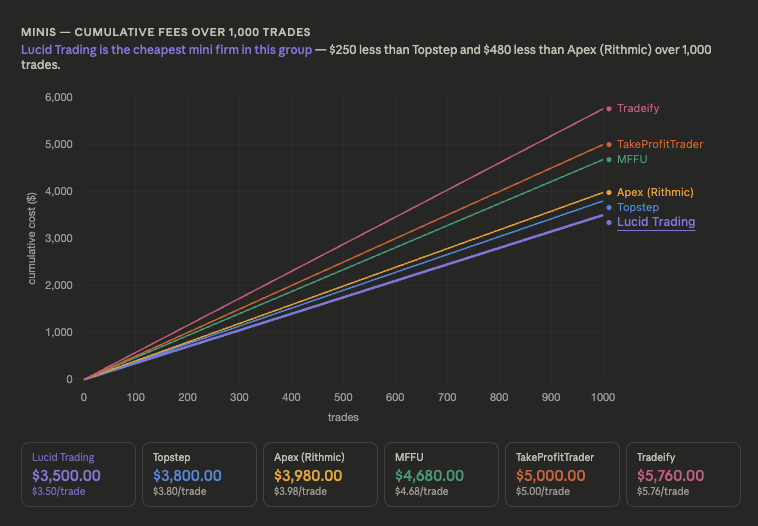
Based on the dataset:
The difference between the lowest and highest cost providers exceeds $2,000 over 1,000 trades.
For active traders, 1,000 trades can occur faster than expected.
Small Costs Compound Quickly
Consider a trader placing 5 trades per day on micro contracts:
At $1.90 per round trip:
$9.50 per day
$47.50 per week
$190 per month
$2,280 per year
Increase trading frequency or number of contracts and these costs scale proportionally.
For scalpers targeting small repeatable gains, transaction costs can represent a meaningful percentage of expected profits.
Professional traders always factor execution costs into their strategy design.
Slippage The Invisible Cost
Another invisible cost is slippage.
Slippage occurs when a trade fills at a worse price than expected due to market movement or liquidity conditions.
Example:
Expected entry 5000.00
Actual fill 5000.25
That small difference may seem insignificant, but repeated across many trades, slippage can exceed commissions in total impact.
Slippage tends to increase during:
Many traders fail to track slippage, which can make a strategy appear more profitable on paper than it is in reality.
Why This Matters for Prop Traders
Prop firm evaluations already come with strict constraints:
If costs eat too much into your expected return, staying profitable becomes significantly harder.
For example, a strategy targeting 4 to 6 points per trade must still overcome:
When trading costs are high, traders often feel pressure to trade more frequently to compensate — which can actually make the problem worse.
Experienced traders focus on quality setups and consistent base hits, allowing small gains to compound over time.
How Smart Traders Manage Trading Costs
Successful traders understand that execution costs are part of their edge.
They:
Having a strong strategy is critical.
But ignoring costs can quietly reduce the probability of long-term success.
Bottom Line
Not all prop trading costs are equal.
Commissions and slippage may seem small individually, but over time they can materially impact performance.
If you are working hard to build an edge, protecting that edge means understanding the true cost of every trade.
Because in prop trading, success is not just about making money.
It is about keeping more of what you make.
Compare the best current prop firm deals
We track the latest discounts across top prop firms so you can reduce costs and maximize your edge:
 https://proptraderedge.com/discounts/