




Most traders watch price.
But price alone does not tell you where the market actually wants to do business.
That is where Point of Control trading, or POC trading, comes in.
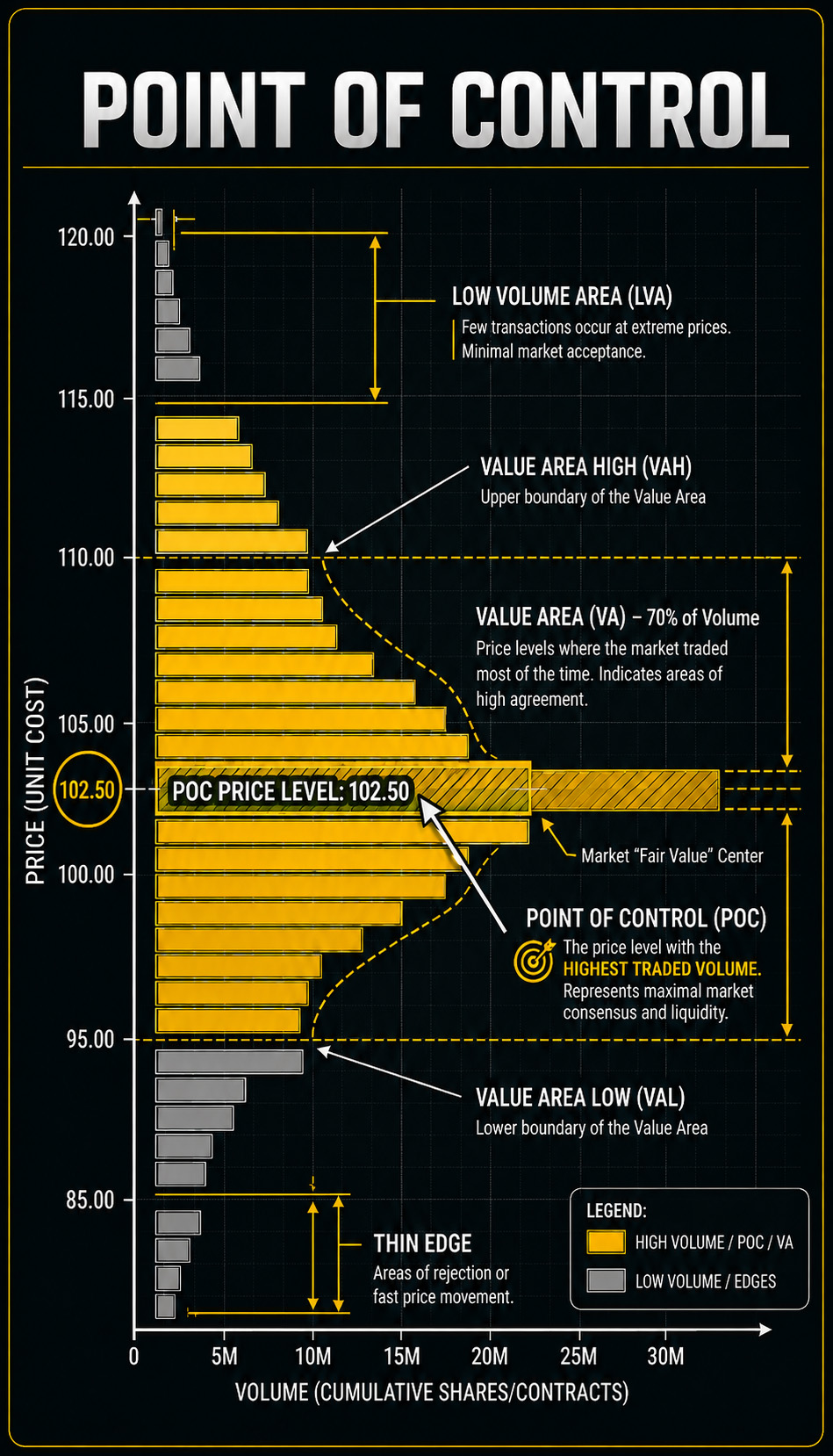
The POC is the price level where the most volume traded during a specific period. On a volume profile, it is usually the longest horizontal bar.
Think of it as the price where buyers and sellers agreed the most.
That makes it one of the most useful reference levels for understanding where the market sees value, where price may rotate back to, and whether a move is being accepted or rejected.
Here is how we use it.
1. Use Point of Control Trading as a Mean Reversion Target
The first setup is simple.
When the market is balanced and price moves too far away from the Point of Control, POC can act like a magnet.
For example, say NQ has spent most of the morning trading around 20,500, creating a clear POC there.
Price rallies to 20,560, but the move stalls. Buyers cannot push it higher. Momentum starts to roll over.
If price begins moving back into the prior range, 20,500 becomes a logical target.
The important part is that we are not automatically shorting because price is above POC.
We want to see the market reject the move first.
That could be a failed breakout, reversal candle, momentum shift, or a move back inside the value area.
Let the market show you that the move failed. Then use POC as the destination.
2. Watch How Price Reacts at POC
POC is not automatically support or resistance.
The reaction matters.
If price hits the POC and immediately bounces, that is rejection.
If price cuts through it, comes back, trades through it again, and starts spending time on both sides, that is acceptance.
This distinction can change the entire trade.
Imagine price has been below the POC all morning. Then it breaks above it and holds.
Now buyers are showing that they are comfortable doing business at higher prices.
Instead of looking to fade the move, we may look for a pullback into the POC and see if it holds as support.
That gives us a much cleaner decision point.
3. Combine POC With VAH and VAL
POC becomes even more useful when you combine it with Value Area High (VAH) and Value Area Low (VAL).
The value area represents the zone where most of the trading took place.
You now have three key levels:
One of our favorite situations is when price briefly trades outside value and then moves back in.
For example, price drops below VAL, fails to continue lower, and reclaims the level.
The POC can now become the first logical upside target.
If price reaches POC and continues through it with momentum, VAH becomes the next area to watch.
Now you are trading from one clearly defined reference level to another.
4. Use POC to Manage the Trade
POC is not only useful for entries.
It can also help with exits.
If you are trading a move back into value, POC can be a logical place to take partial profits.
If you are trading a breakout, a successful POC retest can help confirm that the move is holding.
It gives you a level where you can make a decision instead of guessing.
The Biggest Point of Control Trading Mistake
Do not treat POC like a magic line.
Price does not have to reverse there.
Use it with the rest of your analysis: market structure, trend, VWAP, previous highs and lows, opening range levels, and momentum.
The Point of Control tells you where the market has done the most business.
What price does when it gets back there tells you what to do next.