





In Part 2, we looked at the Sweep and Reclaim, where NQ breaks a premarket level, fails to hold outside it, then reverses back into the range. Range Containment can start almost the same way, which is why the two setups are easy to confuse on a 5-minute chart.
The difference is what you expect after that failed move. With a Sweep and Reclaim, you are trading one failed breakout as the start of a reversal. With NQ premarket range containment, you are betting that neither side is taking control and NQ will continue rotating between the premarket high and low. That makes Range Containment less of a single setup and more of a market condition.
Wait for the Opening Range First
As with the other setups in this series, the pre-market range is defined as 4 AM-9:30 AM ET. We start by letting the 15-minute Opening Range Breakout, or ORB, window form from 9:30 to 9:45 AM ET. The first 15 minutes after the cash open can be extremely noisy as institutional orders hit the market, overnight positions get adjusted and traders react aggressively to the opening move.
Rather than fading every early push, we want to see whether NQ can actually escape the premarket range. Range Containment becomes more interesting when the cash session opens comfortably inside the premarket range and the ORB also remains largely between the premarket high and low.
That tells us something important. The market has opened, volume has increased, and yet neither buyers nor sellers have been able to take control. The premarket range is still holding.
What NQ Premarket Range Containment Looks Like
The cleanest Range Containment sessions tend to feel balanced. NQ opens somewhere around the middle of the premarket range, five-minute candles begin overlapping, and price moves in both directions rather than producing a strong opening drive.
NQ may test the premarket high, reject it and rotate back toward the middle. Later, it may test the premarket low, reject that level and move higher again. That repeated rejection from both sides is what starts to confirm that the market is contained.
Suppose the premarket high is 29,650 and the premarket low is 29,450, putting the midpoint around 29,550. After the ORB, NQ pushes slightly above PMH to 29,668 but closes the 5-minute candle back inside the range at 29,638.
At that point, it could still be a Sweep and Reclaim. But instead of trending lower, NQ rotates toward the midpoint, stalls, then later tests 29,455 and rejects the premarket low. Now both sides of the range have held.
If price later rotates back toward PMH and rejects again, the market is giving us a different message. It is not trending. It is stuck inside the box, and that is when Range Containment becomes the trade.
Sweep and Reclaim vs. Range Containment
This distinction matters because the two setups can have almost identical entry candles. With a Sweep and Reclaim, the failed break itself is the setup. NQ sweeps PMH or PML, reclaims the level, and we trade in the opposite direction.
The midpoint of the premarket range is usually the first target, with the opposite side potentially becoming a larger objective. It is mainly a one-sided trade idea. If NQ sweeps PMH and reclaims it, we are looking short. We are not automatically planning to buy PML later.
Range Containment is different. The first failed break is simply evidence that the range may still be controlling price. If the market continues rotating rather than trending, we are willing to fade both edges.
At PML, we can look for longs. At PMH, we can look for shorts. The goal is not to capture one large directional reversal. It is to take advantage of repeated rotations inside the range while that range remains intact.
You Don't Need a Dramatic Sweep
Range Containment also does not require a large stop run. Price may move only a few points through PMH or PML before returning inside. It may simply touch the level and stall, or it may never actually trade beyond the level but repeatedly fail to close through it.
What matters is that the market is rejecting expansion. At PML, we want to see evidence that sellers cannot hold below the level. That could be a small sweep followed by a 5-minute close back above PML, or repeated tests that fail to produce continuation.
At PMH, we look for the opposite. The key is not how dramatic the rejection looks, but whether price is being accepted outside the premarket range. If it is not, the range remains tradable.
Here’s a great example
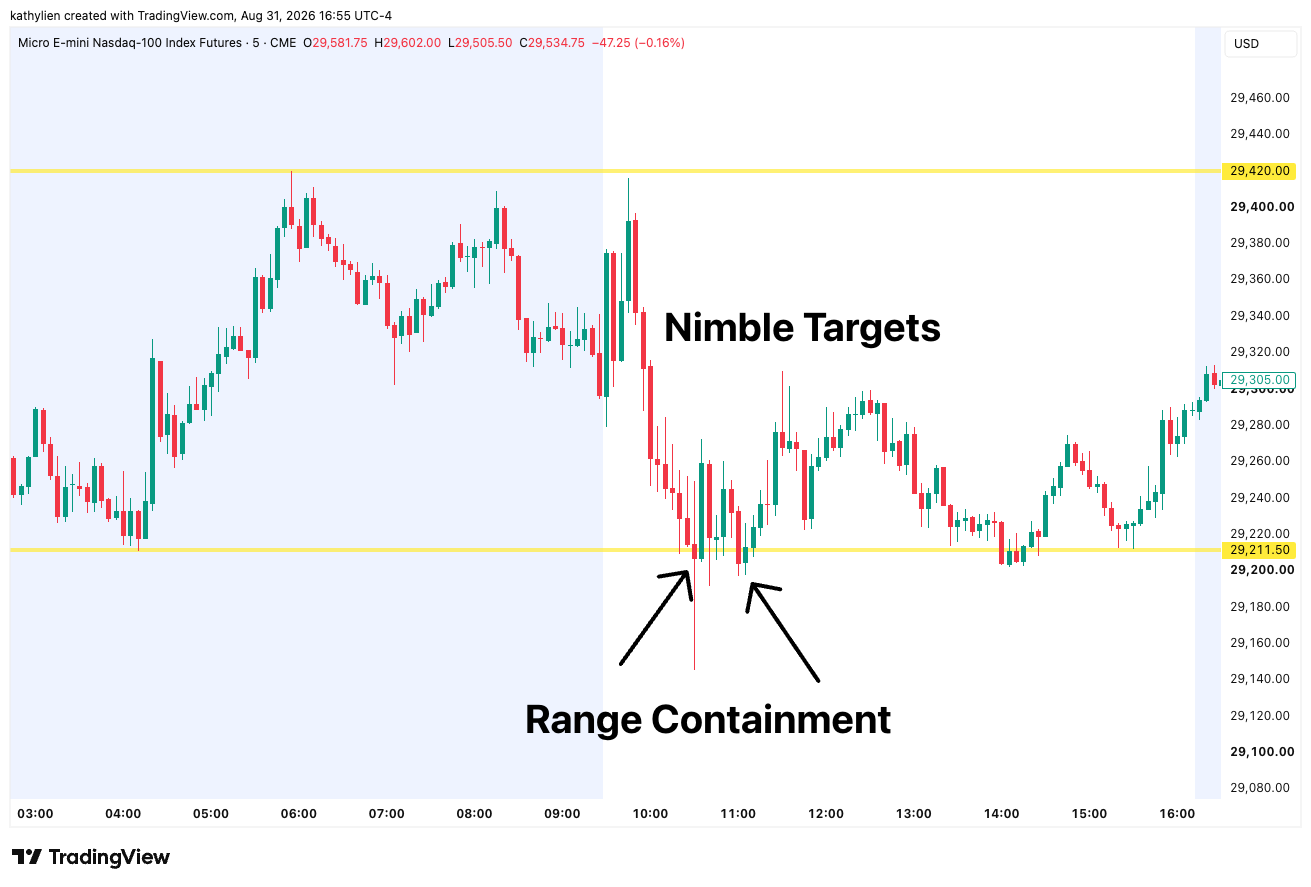
The Midpoint Becomes the First Target
NQ premarket range containment also changes how we think about targets. If you buy near PML, the first objective is generally more conservative than the mid-line or 50% of the pre-market range. You are not betting on trend. You are betting on rotation and the lack of volatility. If momentum remains balanced, you can consider holding a portion toward the opposite side of the range. But there is no need to force a full rotation every time. In a contained market, the midpoint itself can be the biggest part of the trade.
Know When to Stop Fading
The most important rule with NQ premarket range containment is knowing when the range is no longer valid. If NQ breaks PMH, closes above it, retests the level and starts holding above, stop shorting the premarket high.
At that point, the market may be shifting into the Breakout and Retest setup from Part 1. The same applies below PML. Once price begins accepting outside the range, the containment thesis is over.
One of the easiest mistakes is assuming a level has to keep working because it already rejected price once or twice. It does not. Range trading only works while the range remains intact, and once the market proves otherwise, you have to change with it.