





Premarket highs and lows are some of the most watched levels on the chart and there’s more than one way to trade them. In this 3-part series, we're breaking down three setups: Breakout and Retest, Sweep and Reclaim, and Range Containment.
Each works best in a different market environment. Part 1 starts with the breakout and retest.
First, Define Your Premarket Range
Because NQ trades nearly 24 hours a day, traders define "premarket" differently. The most common ranges are 4:00 AM to 9:30 AM ET, the full Globex session from 6:00 PM to 9:30 AM ET, or 3:00 AM to 9:30 AM ET starting around the London open.
We prefer 4:00 AM to 9:30 AM ET. There isn't one perfect definition, but consistency matters. Pick one range and stick with it so the levels you're trading are calculated the same way every day.
Once you mark the premarket high, or PMH, and premarket low, or PML, you can start watching for the first setup.
Setup #1: Breakout and Retest
The mistake many traders make is buying the first move above PMH or selling the first break below PML. NQ produces too many false breaks, particularly around the cash open, for that to be enough.
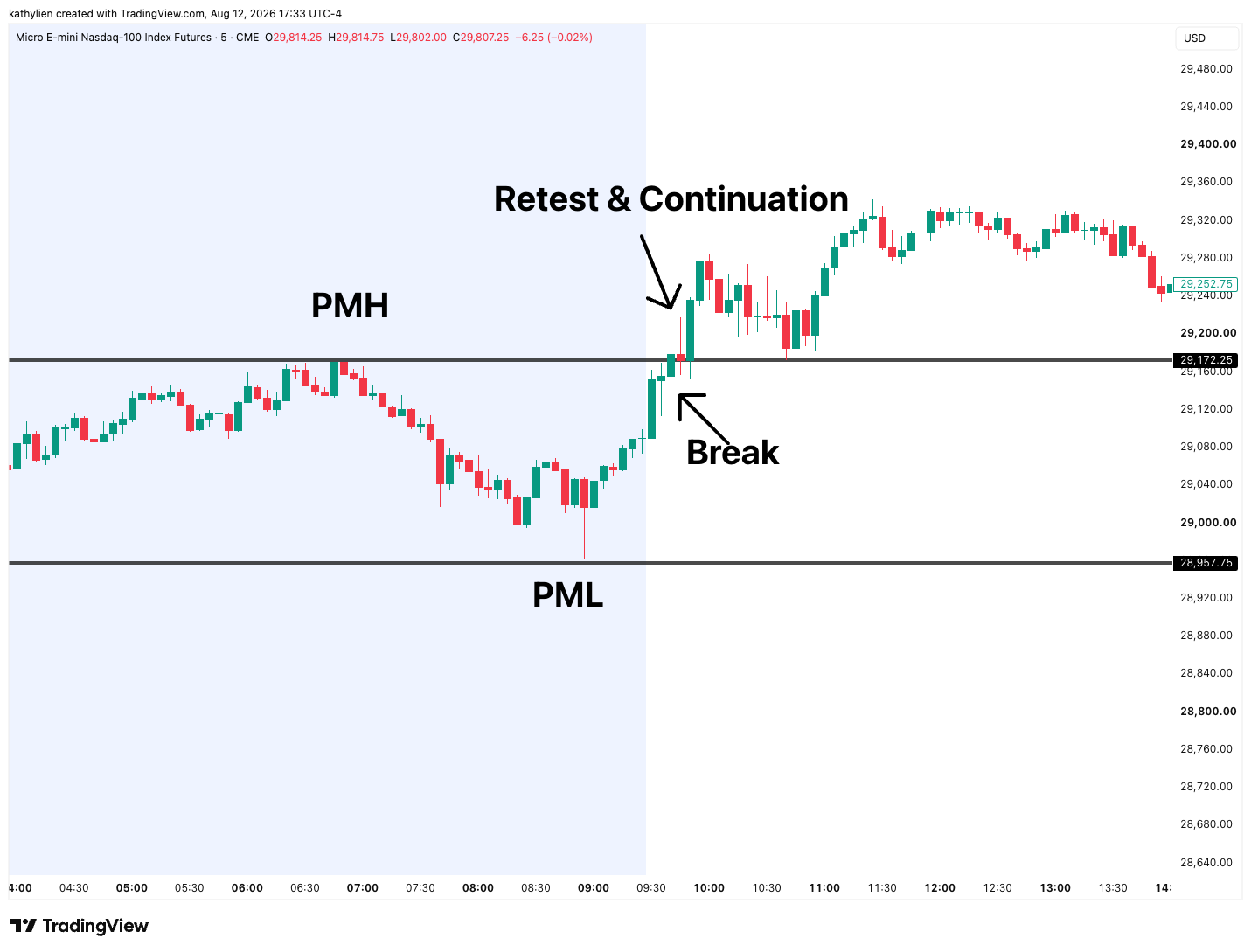
Instead, we want to see a break followed by confirmation. For a bullish setup, that means Break PMH → Pullback → Hold PMH → Continuation Higher.
The retest is the important part. If NQ breaks above PMH and immediately falls back into the premarket range, the breakout hasn't proven much. But if price breaks through PMH, pulls back and buyers defend the level, former resistance may be turning into support. Here’s a classic example
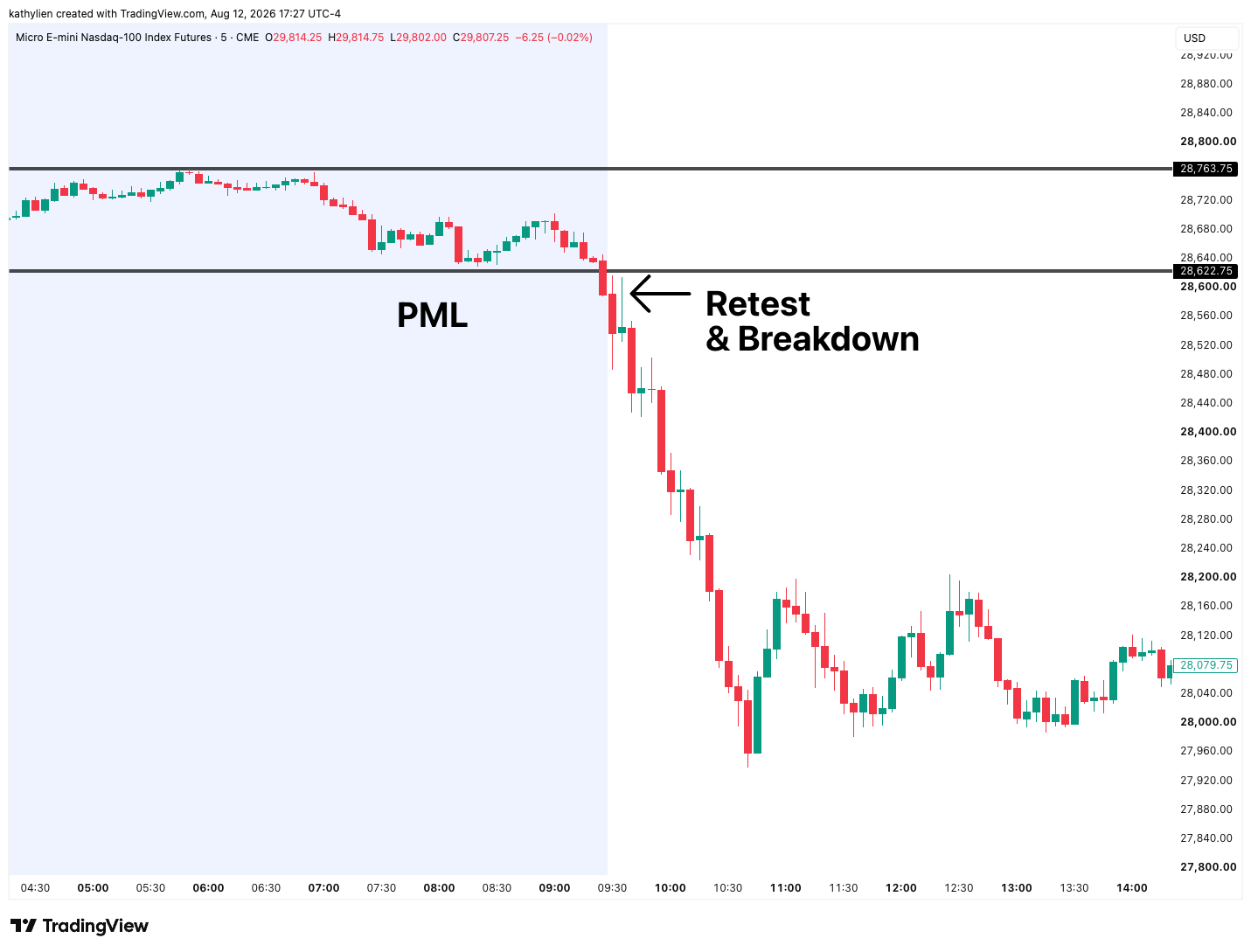
The same setup works in reverse below the premarket low. NQ breaks PML, retests it from below, fails to regain the level and then continues lower.
Why We Wait for the Retest
The 9:30 AM open can be extremely noisy. Institutional orders hit the market, overnight traders adjust positions and momentum traders pile into whatever direction is moving fastest.
That makes the first 15 minutes especially vulnerable to false breakouts. NQ can push 10, 20 or more points through a clean premarket level, attract breakout traders and then reverse right back through it.
Waiting for the retest means you may give up the first few points of the move, but you gain something more important: evidence that the market is actually accepting prices outside the premarket range.
Range Width Matters
Before trading a breakout, look at how much NQ has already moved overnight. One useful reference is the 20-day Average True Range, or ATR.
As a rough guideline, if the premarket range is less than about 40% of the 20-day ATR, breakout setups become more interesting. A relatively narrow overnight range suggests volatility may still be compressed and the larger move could still be ahead.
For example, if NQ normally travels around 300 points in a day but has only moved 100 points before 9:30 AM, there may still be plenty of room for expansion. If it has already traveled most of its normal daily range before the cash open, chasing another breakout becomes less attractive.
That's when one of the other setups in this series may make more sense.
Look for Confluence
Premarket levels become more interesting when they line up with another price traders are already watching. That could be the prior day's high or low, VWAP, a major round number, or another important support or resistance area.
A premarket high sitting within a few points of the prior day's high is generally more meaningful than a PMH sitting by itself in the middle of nowhere. The more reasons traders have to focus on the same area, the more attention we give it.
Watch Where NQ Opens
The location of the 9:30 AM open also changes how we treat the level. If NQ opens inside the premarket range, PMH and PML can act as natural breakout triggers.
But if NQ is already trading above PMH before the cash open, that level may behave more like support on a pullback than a fresh breakout trigger. The level hasn't changed, but the context has.
That's why PMH and PML should never be traded in isolation.
Don't Force a Tight Stop
NQ can easily wick through a clean technical level before continuing, so putting a stop just a couple of ticks beyond PMH or PML can get you shaken out of an otherwise good trade.
Let market structure determine where the setup is invalidated. If the proper stop is larger than you're comfortable with, reduce your position size or wait for a better retest entry rather than forcing the stop closer.
The Key Takeaway
The breakout itself isn't the edge. The better setup is when NQ breaks the premarket level, retests it and proves that it can hold. A compressed overnight range and additional confluence can make that setup even more attractive.
But what if NQ breaks the level, draws traders in and then completely fails? That's where our favorite setup comes in.
In Part 2, we'll break down the sweep and reclaim, including the 5-minute confirmation.