




Every morning, the market tells a story - but most traders start trading before they actually understand what the market is saying.
After more than 20 years in the markets, one of the biggest lessons I’ve learned is this: timing matters just as much as direction.
Instead of guessing where price will go, professional traders often wait for the market to establish its early range and then trade in the direction of institutional momentum.
One of the most effective ways to do this is by using the Initial Balance (IB).
This framework is widely used by futures traders and prop traders because it provides structure, clarity, and repeatable opportunities.
In this guide, we’ll focus on the 60-minute Initial Balance breakout and how beginners can use VWAP or Fair Value Gaps (FVG) to identify high-probability entries with defined risk.
Why the Initial Balance Is PopularWith Futures and Prop Traders
The Initial Balance is one of the most widely used intraday frameworks among futures traders and prop traders because it helps traders build a directional bias using actual market behavior rather than prediction.
The concept comes from Market Profile methodology and defines the first hour of trading as the market’s initial consensus of value.
For traders operating under prop firm rules, structure is critical.
Prop traders typically need:
The Initial Balance helps provide all four.
Because of this, many traders at prop firms begin their day by marking the IB high and low and waiting for the market to reveal its bias before entering trades.
What Is the Initial Balance?
The Initial Balance is the price range formed during the first hour of trading.
For US markets:
Initial Balance period = 9:30 AM to 10:30 AM New York time
During this first hour:
Instead of guessing direction, traders allow the market to establish this range first.
Why the 60-Minute Initial Balance Matters
The first hour often contains some of the most important order flow of the day.
When price breaks out of this range, it can signal that buyers or sellers are gaining control.
Historical testing shows that once price breaks one side of the Initial Balance, it often continues in that direction rather than fully reversing to the opposite side of the range during the same session.
According to Edgeful data, 77% of trading sessions over a 6-month study period only broke one side of the Initial Balance, meaning price did not travel to both the IB high and IB low in the same day. Longer-term studies show similar behavior patterns, reinforcing the tendency for directional continuation once the market establishes momentum.
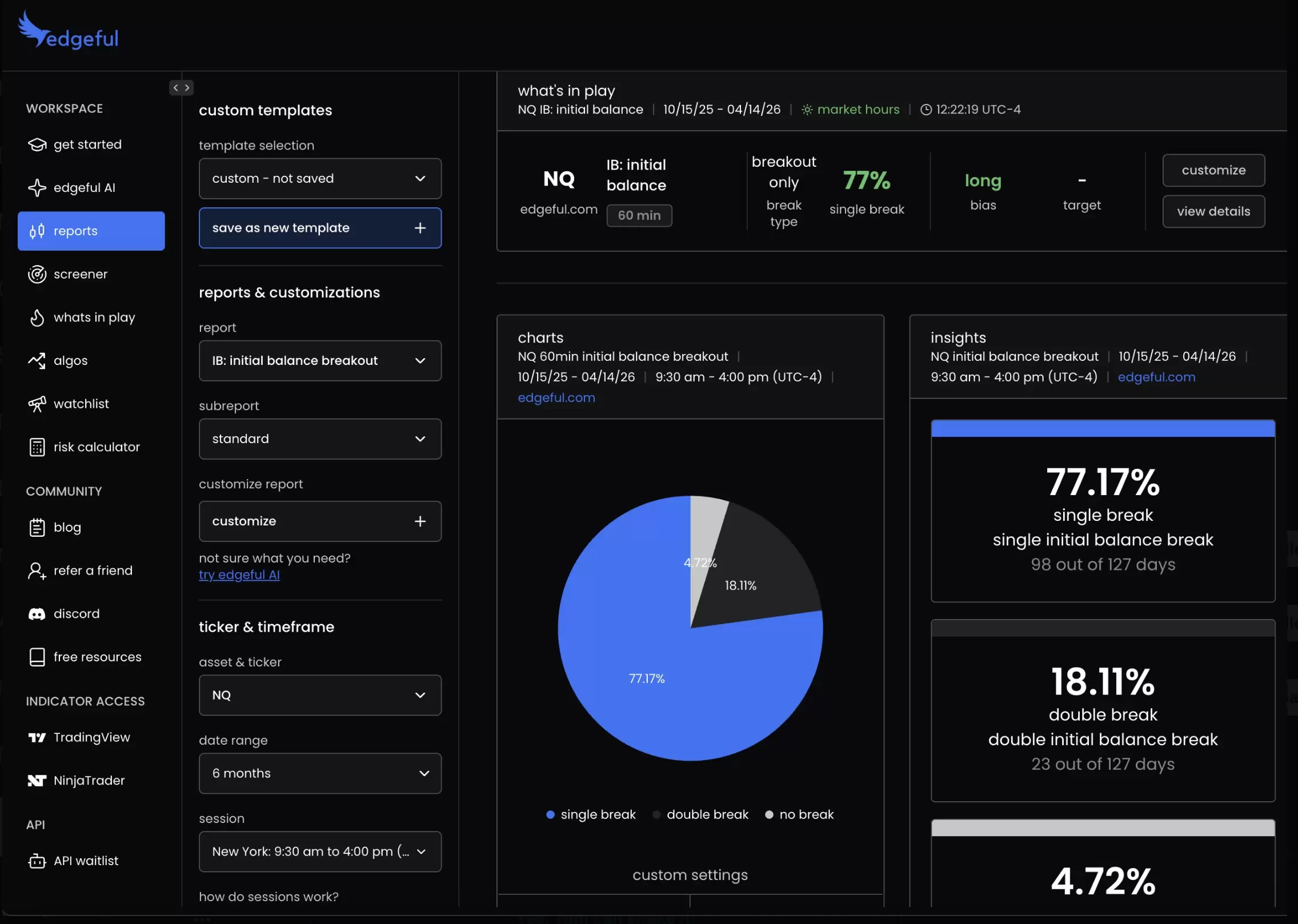
This helps traders form an early bias and focus on trading in the direction of strength rather than fading momentum.
Step 1: Mark the 60-Minute Initial Balance
On your chart:
This range becomes the framework for the rest of the session.
Step 2: Wait for the Breakout
Once price breaks above or below the Initial Balance range, you have a directional clue.
Break above IB high → bullish bias
Break below IB low → bearish bias
Rather than chasing price immediately, many professional traders wait for a pullback to a structured level where risk can be defined clearly.
Two of the most common tools used alongside the Initial Balance are VWAP and Fair Value Gaps (FVG).
Step 3: Use VWAP or Fair Value Gaps for Entries
VWAP (Volume Weighted Average Price)
VWAP represents the average price institutions have transacted during the session.
When price breaks the Initial Balance and holds above VWAP, it suggests buyers remain in control.
Pullbacks toward VWAP often act as support in trending markets.
Fair Value Gap (FVG)
A Fair Value Gap forms when price moves strongly in one direction, creating an imbalance between buyers and sellers.
Price often retraces partially into this gap before continuing in the direction of the breakout.
This allows traders to enter at a more favorable level rather than chasing momentum.
Example Trade: NQ Initial Balance Breakout with FVG
Let’s walk through a simple example using Nasdaq futures (NQ).
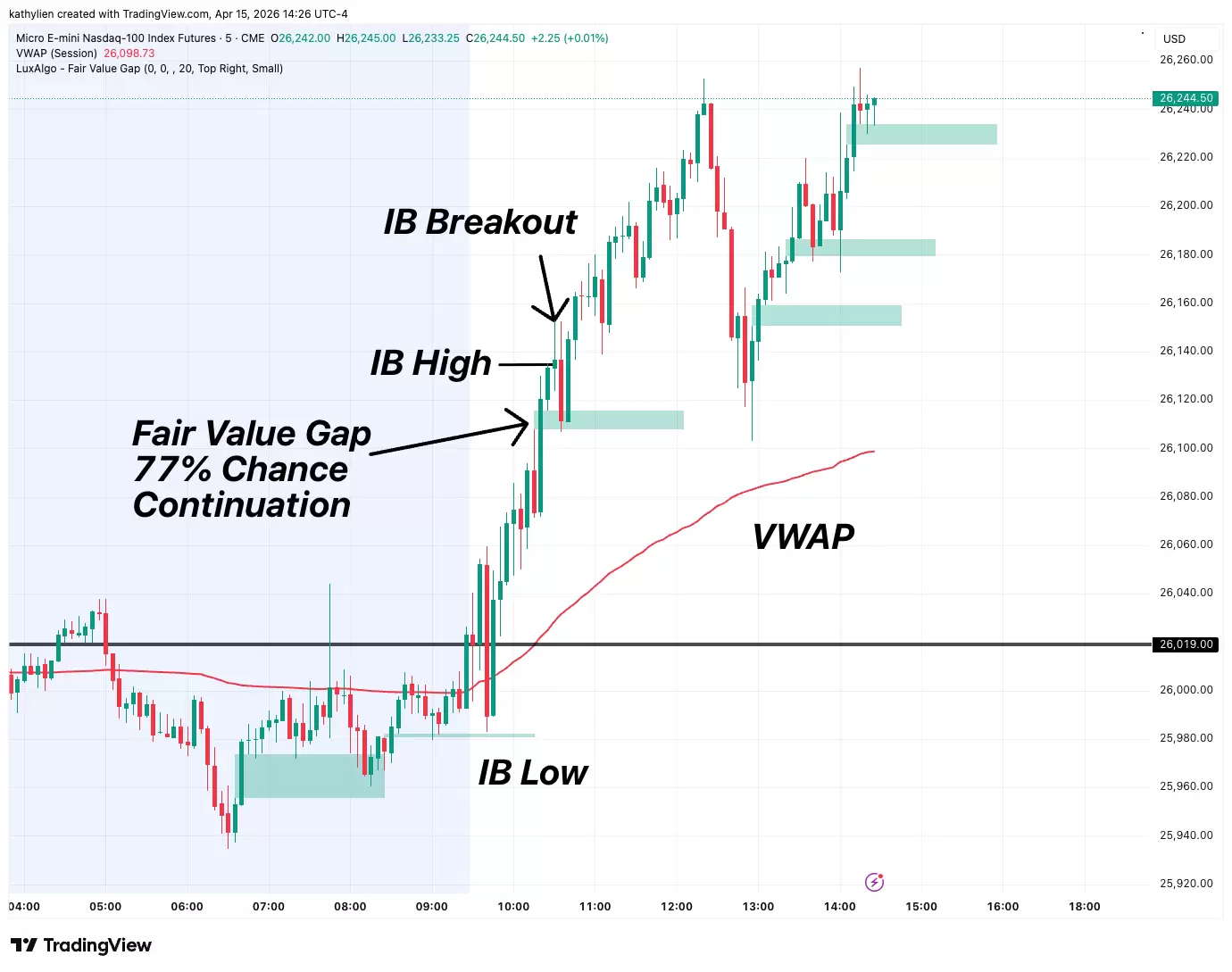
If the market is trending strongly - for example when NQ is trading at 2-month highs - traders may choose to trail the trade using a short-term moving average such as the 9 EMA.
This allows participation in extended moves while protecting profits if momentum slows.
Why This Approach Works for Beginners
The Initial Balance provides structure.
VWAP and FVG provide location.
Together, they help traders:
Instead of predicting every move, traders focus on reacting to what the market is already doing.
Simple Rules to Follow
Long Setup
Short Setup
Used Across Most Prop Firms
The Initial Balance breakout is widely used across many prop trading firms because it provides a rules-based framework that can be applied consistently across markets such as:
Its structured nature makes it particularly useful for traders working within drawdown limits and consistency requirements.
If you are exploring prop trading opportunities, Prop Trader Edge provides regularly updated comparisons, reviews, and exclusive discounts.
 View the best prop firm discounts here: https://proptraderedge.com/discounts/