




The US midterm elections are next Tuesday, November 3, and if history is any guide, they could set the stage for some very interesting moves in stocks and gold. The US dollar, however, is a different story.
Most traders think about elections in terms of which party wins and which policies could change. But when I look at elections, I am much more interested in how markets have historically behaved before and after the vote, and whether those patterns can help us identify trading opportunities.
Midterms determine control of Congress for the second half of a president's term. Republicans currently control both chambers, but their House majority is narrow. A shift to divided government could complicate the administration's ability to pass legislation on taxes, spending and trade.
For markets, the uncertainty leading into an election can be just as important as the outcome itself. And this is where the historical data gets interesting.
Stocks: 21 Out of 23 Midterm Elections Have Been Followed by a Rally
Of the three markets, the S&P 500 has by far the strongest historical pattern.
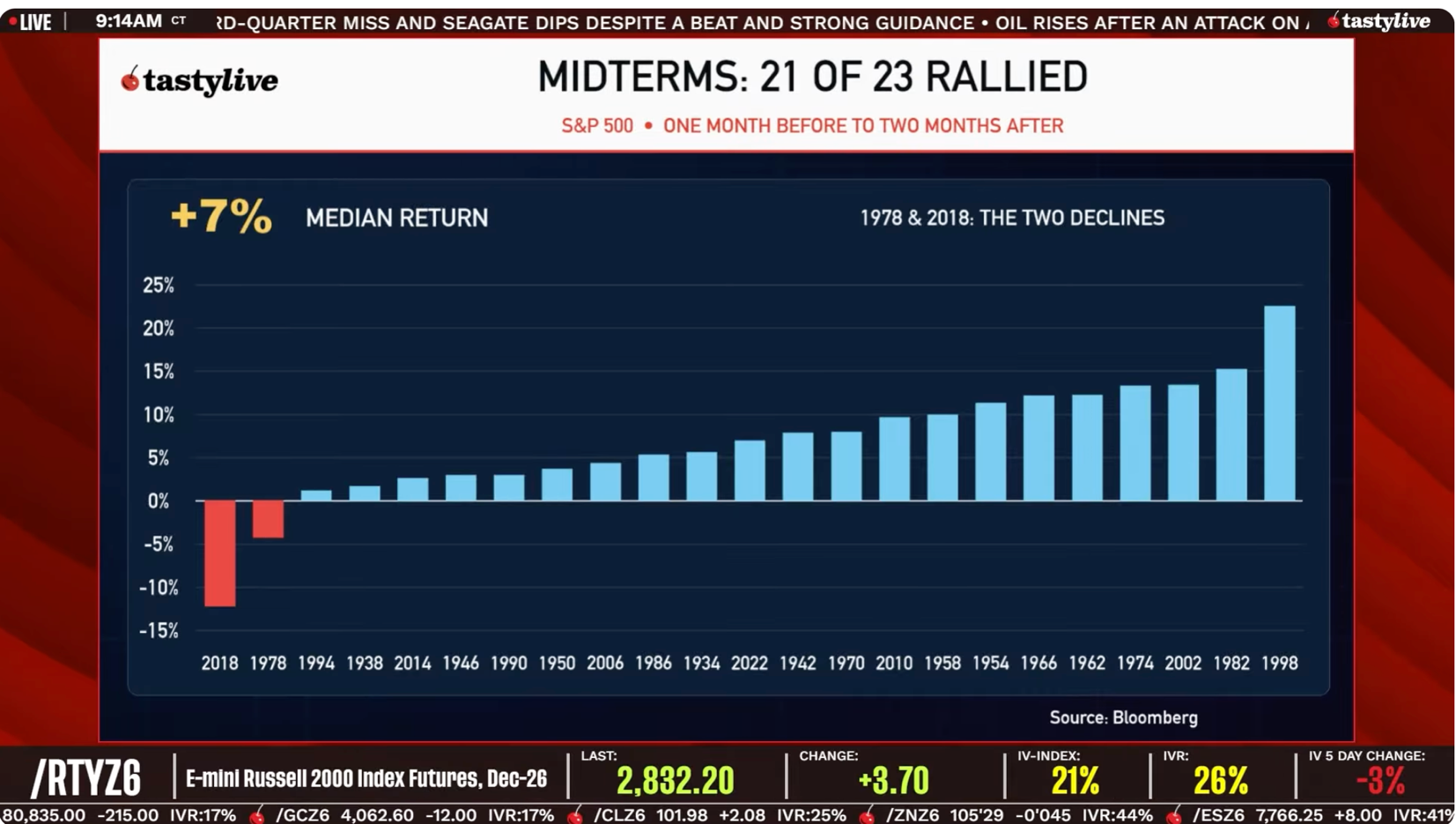
In 21 of the last 23 midterm election cycles, the S&P 500 rallied between one month before the election and two months afterward, with a median return of approximately 7%. The only exceptions were 1978 and 2018.
That is a remarkable track record, spanning both Republican and Democratic administrations, inflationary periods, recessions and very different interest rate environments. The S&P 500 has also been higher 12 months after every midterm election since 1950.
Why? Markets hate uncertainty. Leading up to an election, investors try to price in potential changes to taxes, regulation and fiscal policy. Once the results are known, some of that uncertainty disappears, allowing investors to refocus on corporate earnings, economic growth and monetary policy.
Could the S&P 500 Rally Another 7%?
The S&P 500 is already up approximately 12.8% year to date, based on the October 27 close. But after correcting from its early October highs, the market has also worked off some of its previously overbought conditions.
That potentially creates room for another leg higher if the historical post-midterm pattern plays out.
Of course, a 7% historical median does not mean we should automatically expect another 7% rally. Elevated interest rates, persistent inflation and geopolitical uncertainty remain significant headwinds, particularly with the Federal Reserve back in tightening mode.
Still, this is a historical tendency that is difficult to ignore. If the S&P 500 can hold support and break above its recent highs, the post-election period could offer attractive opportunities for momentum traders.
Gold: Down 6% This Year, but History Also Favors a Recovery
Gold has had a very different year from stocks. After reaching a record high above $5,400 in January, gold has fallen sharply as Treasury yields climbed and the US dollar strengthened. It is now down approximately 6% to 7% year to date, leaving it well below its record high.
But history suggests that gold could also have room to recover after the midterms.
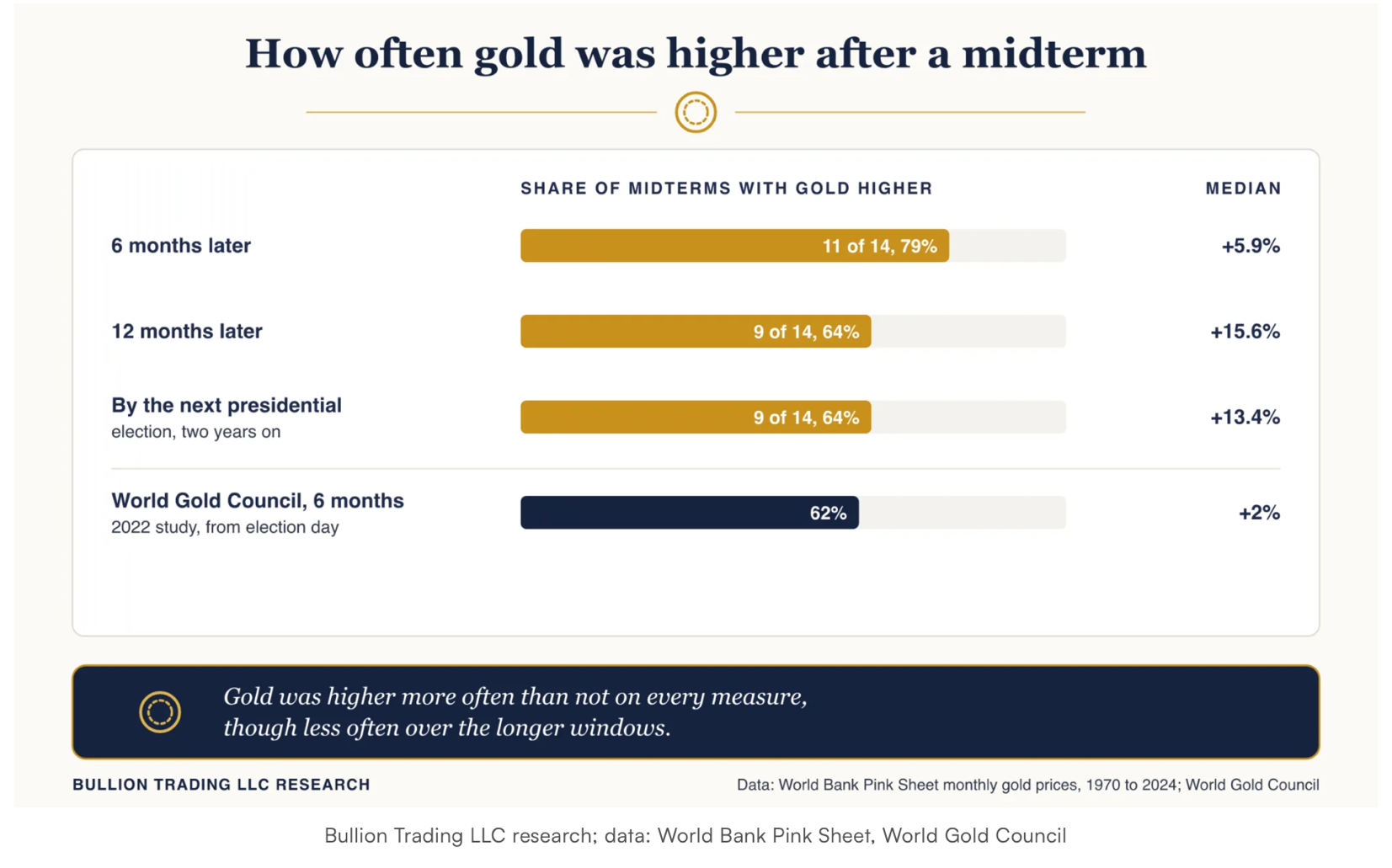
Since 1970, gold has been higher three months after US midterm elections in 9 of 14 cases, or 64% of the time, with a median gain of 3.9% and an average return of 5.8%. Over a6 month basis, the median increase was 5.9%.
That compares favorably with all three-month periods since 1970, when gold rose 55% of the time with a median gain of just 1%.
The longer-term results are also interesting, the median return 12 months later climbs to 15.6%, although gold was higher in 9 of 14 cases.
What stands out to me is that gold does not necessarily rally immediately after the election. The median next-day return has actually been slightly negative at -0.2%, but the historical returns become more favorable over longer periods.
Could Gold Stage a Post-Election Recovery?
With gold already down this year and significantly below its January peak, there is room for a rebound. But there is one important caveat.
Gold's performance has much more to do with the US dollar and interest rates than with which party controls Congress.
The World Gold Council found that changes in congressional control were not statistically significant in explaining gold's post-midterm performance, while movements in the dollar were.
A weaker dollar and falling Treasury yields would support a recovery in gold. But if the Fed continues raising rates and yields push higher, that could delay or undermine any rebound.
For me, the combination of a large correction and favorable historical seasonality makes gold worth watching. But I would want to see confirmation from the dollar, yields and price action before positioning for a sustained recovery.
US Dollar: No Reliable Midterm Pattern, but the Fed Could Be the Wild Card
Unlike stocks and gold, the US dollar has no reliable directional pattern around midterm elections.
Historical studies suggest the dollar has tended to be relatively flat immediately after elections, with modest average declines of approximately 1% to 1.5% over the following three to twelve months. But individual election cycles have produced widely different results.
For currency traders, I think the Federal Reserve matters much more than the election itself.
The Fed just left interest rates unchanged at 3.75% to 4.00%, but its latest statement emphasized that inflation remains elevated and economic activity continues to expand at a strong pace. Importantly, two Fed officials dissented in favor of another 25-basis-point rate hike.
That tells us the Fed is not necessarily finished raising interest rates.
With the midterm elections behind us next week, attention can return to inflation, economic growth and the Fed's next move. Another rate hike remains possible if inflation stays stubbornly high and the economy continues to show resilience.
That could be positive for the dollar, especially if other major central banks are less aggressive. Higher US interest rates and widening yield differentials could support USD/JPY and pressure EUR/USD.
So while stocks and gold have historically benefited from the post-midterm period, I would be careful about applying the same bullish or bearish seasonal assumptions to the dollar.
For the dollar, the Fed is still likely to be the bigger driver, and the next rate hike could matter far more than which party wins Congress.