





There is a new product gaining momentum in prop trading, and it could eventually become a serious threat to both traditional futures and CFDs. They are called perpetual futures, or simply perps.
Perps have been hugely popular with crypto traders for years, but they are quickly moving beyond Bitcoin and Ethereum into stock indices, individual stocks, commodities and currencies. At the same time, a new generation of prop firms is building funded trading programs around them.
The appeal is straightforward. Perps can offer more flexible position sizing, longer trading hours, no expiration dates and transparent market-based pricing. For active traders and prop firms, that is a powerful combination.
What Exactly Are Perpetual Futures?
Traditional futures contracts expire. If you trade Nasdaq futures, for example, you eventually have to move from one quarterly contract to the next as liquidity shifts.
A perpetual future has no expiration date, so the same contract can continue trading indefinitely. Instead of expiration pulling the futures price toward the underlying market, perps normally use a funding mechanism that helps keep the contract aligned with spot prices.
Depending on market conditions, traders who are long may periodically pay traders who are short, or vice versa. For day traders, however, the bigger differences are often the flexibility, trading hours and ease of use.
Granular Position Sizing Is a Major Advantage
Traditional futures still force traders into fixed contract sizes. For Nasdaq, NQ is worth $20 per point and MNQ is worth $2 per point.
Suppose your trading plan allows you to risk exactly $100. With a 25-point stop, two MNQ contracts give you $100 of risk. But with a 40-point stop, one MNQ risks $80 while two risk $160.
Perpetuals can potentially offer much finer increments, allowing traders to size positions more closely around the actual dollar amount they want to risk.
That matters especially in prop trading, where a small difference in position size can have a major impact on daily loss limits and maximum drawdowns.
24/7 Trading Changes the Equation
Traditional futures trade nearly around the clock during the week, but they still close for maintenance and usually shut down over the weekend.
Perps were born in crypto, where markets trade 24/7. As perpetuals expand into indices, commodities, stocks and FX, traders are gaining access to markets outside traditional exchange hours.
That means a major geopolitical event or political announcement over the weekend could be reflected immediately in a perpetual market rather than forcing traders to wait for futures to reopen.
Of course, access does not guarantee liquidity. Weekend and overnight markets can be thinner, spreads can widen and slippage can increase. Still, having the option is valuable.
Why Perps Could Challenge CFDs
CFDs became popular because they offer flexible position sizing, no quarterly rollover, broad market access and simple platforms. A trader can often choose almost any position size the broker permits.
The structural weakness is that the trader's relationship is primarily with the broker rather than a centralized exchange. Pricing, spreads, financing and execution can vary from one CFD broker to another.
Perpetuals could challenge that model by offering similar flexibility with exchange-based or transparent market-derived pricing. In simple terms, traders could potentially get CFD-like position sizing with futures-like price transparency.
That could become a serious competitive advantage if liquidity continues to improve.
CFDs are not disappearing. They have huge distribution, mature platforms such as MT4 and MT5, broad product ranges and very simple onboarding. But perps may be the first product in years that competes directly with the reasons traders like CFDs in the first place.
Why Prop Firms Are Embracing Perpetual Futures
Perps are a natural fit for prop trading because firms want products that are easy to scale, flexible to size and available across many markets.
They also allow firms to build products without depending entirely on traditional futures infrastructure. Some perp firms are crypto-native, some are coming from the traditional futures prop industry, and others are combining prop trading with exchange or on-chain infrastructure.
Several names are already emerging. Breakout, owned by Kraken, is currently the leader by reported payouts, with $9.27 million reported in September and more than $38 million in 2026 year-to-date.
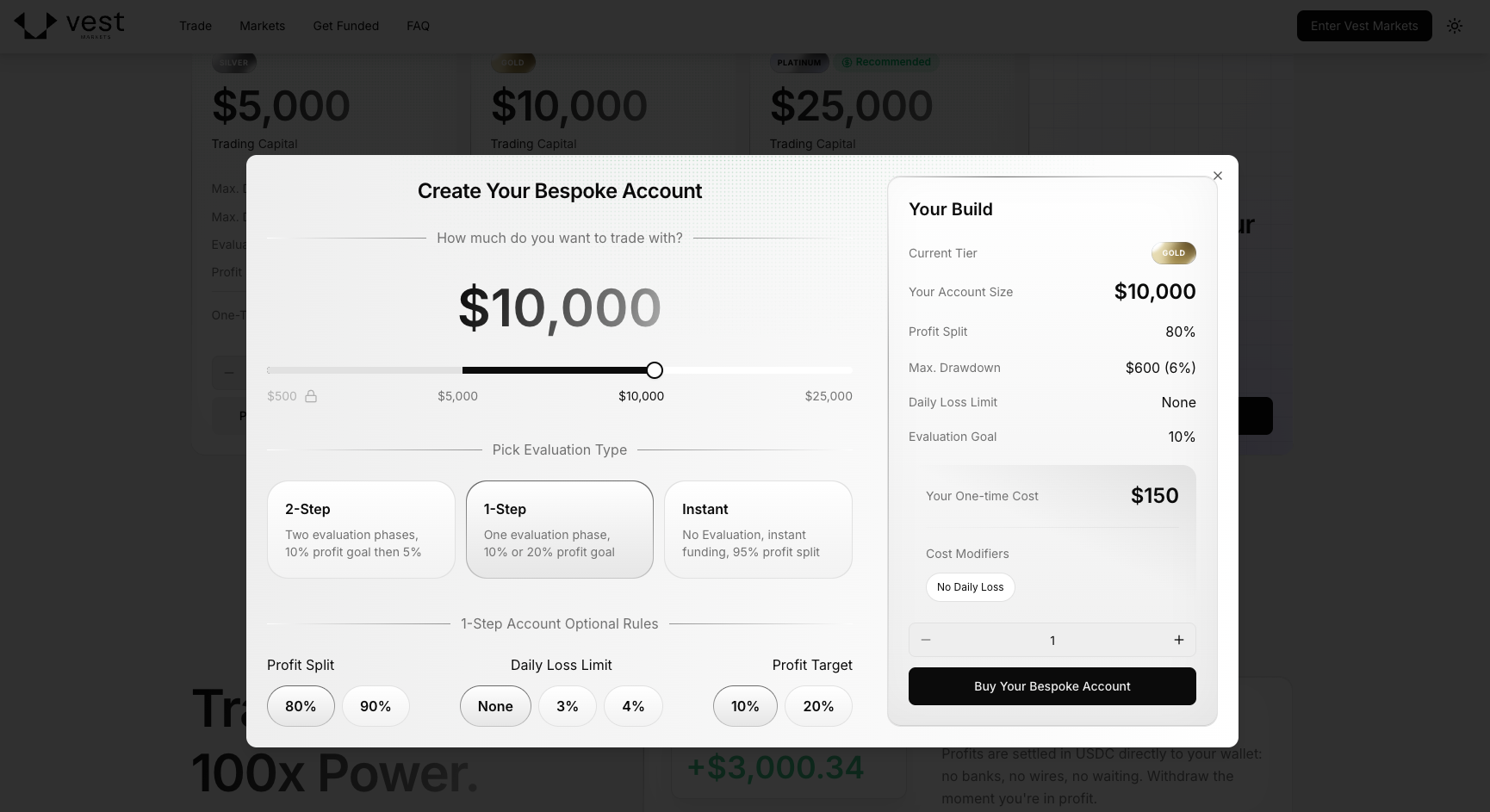
Vest Markets is attracting attention for its static drawdowns, on-demand payouts and multi-asset perpetuals across crypto, stocks, indices and FX. A $5,000 one-step evaluation with no daily loss limit, a static drawdown and an 80% profit split costs $75, while a $10,000 version costs $150 before discounts. The important distinction, however, is that the advertised account size is not the amount of capital a trader can actually lose. On a $10,000 account with a 6% static drawdown, the effective loss allowance is $600, not $10,000. That makes the drawdown limit, rather than the headline account size, the more meaningful number for comparing risk across prop firms.
Propr and Hypernova have also gained traction through Hyperliquid and on-chain payout transparency, while HyroTrader remains one of the more established crypto-perp specialists.
MyFundedPerps, created by the team behind My Funded Futures, shows that established futures prop operators are also moving into the category. Crypto Fund Trader remains another recognizable name, although traders should research its regulatory history before purchasing an account.
Pros and Cons
The biggest advantages are flexibility and simplicity. Perps can allow more precise position sizing, eliminate contract rolls and provide extended trading access. Exchange-based and on-chain markets can also give traders greater visibility into pricing and, in some cases, payouts.
But there are important downsides.
The first is funding cost. Because perps do not expire, traders may pay recurring funding charges that can change with market conditions.
The second is liquidity. CME futures such as NQ and ES have deep institutional markets. A newer perpetual contract may show a tight spread while still having much thinner depth and greater slippage.
There is also basis risk. A Nasdaq perpetual does not necessarily trade at exactly the same price as NQ futures or the underlying index, so strategies built around CME markets may behave differently.
Finally, there is counterparty and prop-firm risk. Many perp prop firms are young, and generous profit splits, static drawdowns and fast payouts only matter if the business remains sustainable.
That is why transparency matters. Reported payouts, independently verifiable on-chain payouts and marketing claims should not be treated as the same thing.
Futures, CFDs or Perps?
There probably will not be one winner. Traditional futures remain difficult to beat for traders who want deep liquidity, regulated exchanges and standardized products. CFDs remain highly convenient for flexible sizing and broad market access.
Perpetual futures sit somewhere between the two.
They combine much of the flexibility of CFDs with some of the market structure advantages of futures, while adding continuous trading and no expiration.
That is why the rise of perp prop firms matters. This is not just another crypto niche. If perpetual markets continue expanding into Nasdaq, S&P 500, gold, stocks and FX, they could become one of the most important new product categories in retail and prop trading.