





Tensions in the Middle East are elevated again, and with each passing day, the risk of a broader conflict grows. If a full-blown war breaks out, it won’t be geopolitical noise.
It will be a volatility event.
For retail traders, that means opportunity and serious risk.
For prop traders, it could mean the difference between payout and breach.
Why This Matters for Markets
When geopolitical risk rises, multiple asset classes react at the same time:
And the moves are not gradual.
They gap.
Liquidity thins.
Spreads widen.
Slippage increases.
This is where traders get caught.
Why Prop Traders Are More Exposed
If you trade your own account, volatility hurts.
If you trade a prop account, volatility can end your account.
Prop firms enforce:
A 25-point move in gold during thin liquidity can breach a daily limit in seconds.
Weekend gap risk is even worse. If you are trading gold cfds and headlines break while markets are closed, your stop may not protect you. You can wake up past your max loss before Monday begins.
And here’s the trap: volatility tempts traders to oversize.
Bigger candles feel like bigger opportunity.
But in prop trading, survival is the opportunity.
How to Trade a War Market Without Blowing Up
1. Be Quick or Stay Flat
The cleanest move often happens in the first 30–60 minutes after a major headline. After that, reversals become more likely. If you catch the spike, take profits.
If you are not built for fast execution, staying flat is a strategy.
2. Avoid Weekend Exposure
In high-tension environments, holding trades over the weekend dramatically increases gap risk. Even if gaps fill later, your prop account may not survive to see it. Close your positions before the weekend.
3. Let Structure Form
After the initial spike:
This keeps you from getting chopped while the market is still digesting information.
4. Trade Smaller Than You Think
War markets expand ranges. Your normal size is likely too large. Cutting size protects drawdown and keeps emotion in check.
5. Expect Short-Lived Extremes
This is critical.
War trades are often violent.
They are often emotional.
And they are often short-lived.
The Lesson From 12-Day War in June 2025
We saw this clearly during the 12-day war that began on June 13, 2025, when Israel attacked Iran. The conflict lasted until a U.S.-brokered ceasefire took effect on June 24.
Look at what gold did.
Gold rallied ahead of the attack as tensions escalated. Fear was building. Traders positioned defensively.
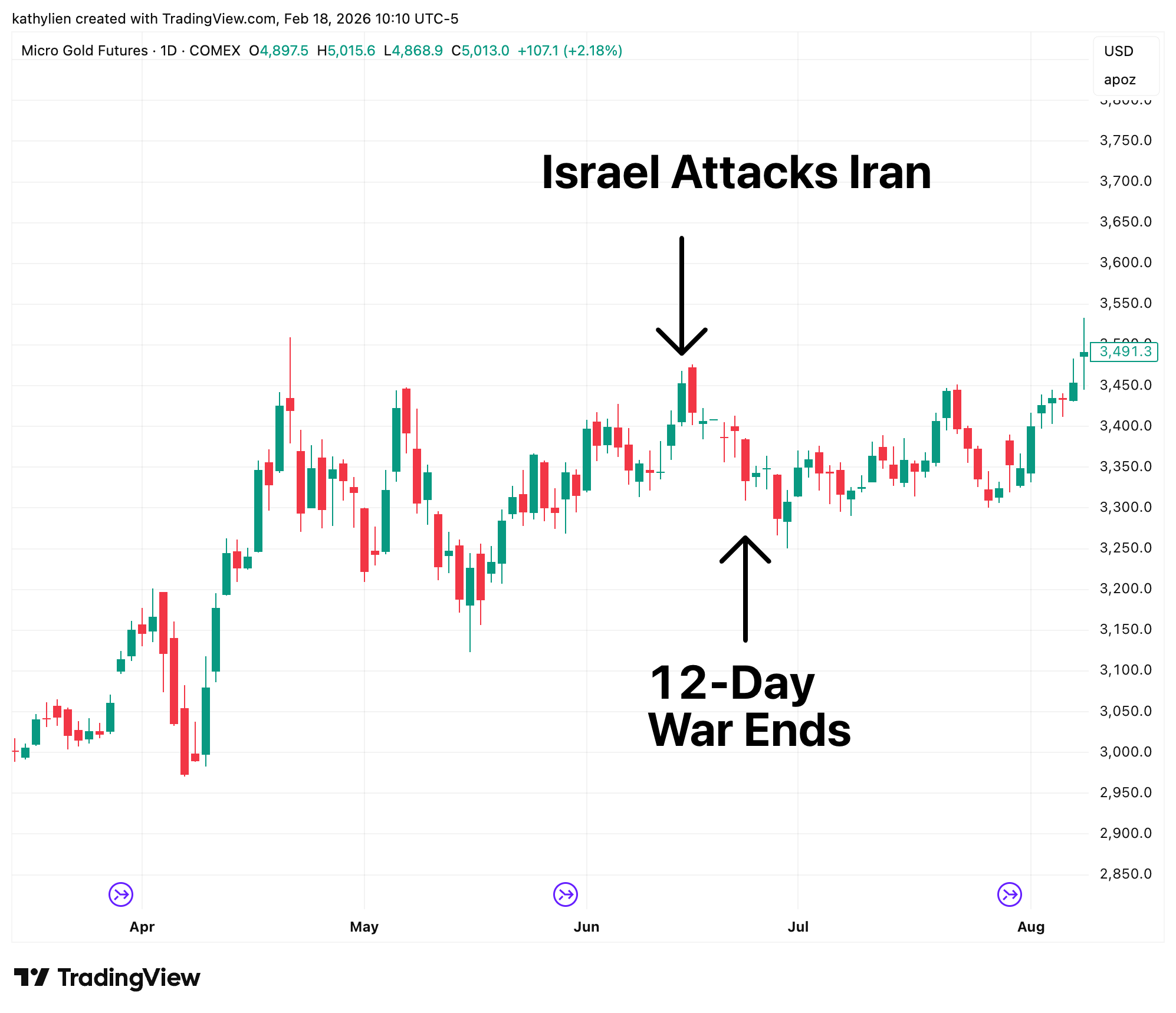
Then the war began.
And gold fell during the conflict.
Why?
Because markets had already priced in fear. Once the event became defined rather than hypothetical, uncertainty declined. Defensive positioning unwound. The panic premium faded.
By the time the ceasefire arrived, much of the move had already reversed.
That is how war markets often behave.
The anticipation phase can be stronger than the war phase.
Where Can You Trade Gold Right Now?
If volatility increases and you want access to gold markets, make sure you’re with firms that still allow metals trading.
For futures traders, firms like Tradeify continue to offer gold contracts.
If you prefer the CFD route, firms such as Hola Prime (code EDGE), ThinkCapital (code EDGE), and Axi Select provide access to gold without exchange-based CME restrictions.
Different models carry different risks and structures, so understand the rules - especially drawdown policies and margin treatment - before increasing exposure in volatile conditions.
Access matters.
Flexibility matters.
But risk control matters most.
Risk. Opportunity. Discipline.
If escalation occurs now:
But remember:
Markets react hardest to uncertainty — not necessarily to the event itself.
In a prop account, the goal is not to predict war.
It is to survive volatility.
The traders who thrive in uncertain environments are not the most aggressive.
They are the most prepared.
Because the only thing worse than being wrong…
Is being right - after you’ve already breached.