




Monday’s trading session in oil was a textbook example of how violent commodity markets can become when geopolitics collide with thin liquidity. At one point, crude oil surged to $119 per barrel, only to collapse below $90 before eventually stabilizing and turning positive on the day. That’s a more than 30% intraday swing.
Moves like that are rare, but when they happen, they create both enormous opportunity and enormous risk.
The catalyst behind the volatility was escalating tension involving Iran and fears of supply disruptions in the Middle East. Whenever headlines involve the Strait of Hormuz, markets react immediately because roughly 20% of the world’s global oil supply moves through that shipping route.
But geopolitical spikes in commodities often produce temporary panic rather than sustainable trends. Traders rush to price in worst-case scenarios, which frequently pushes prices to extremes before cooler heads prevail.
That’s why oil is one of the best markets to trade mean reversion during headline-driven events.
Using the Third Standard Deviation
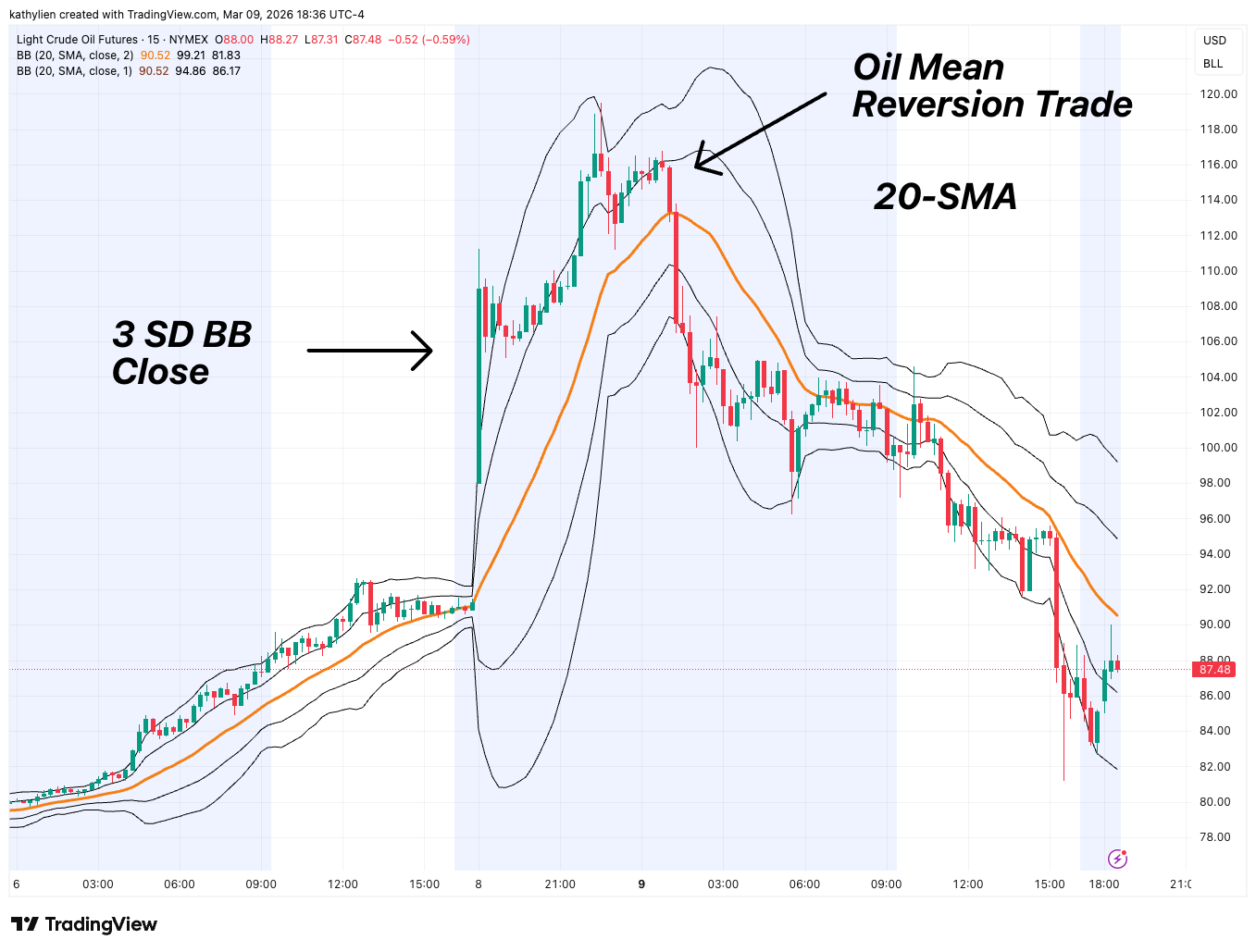
One way to identify these extremes is by using the third standard deviation Bollinger Band on a 15-minute chart.
A standard deviation measures how far price moves away from its average. Traditional Bollinger Bands plot two standard deviations above and below a moving average, which statistically contains about 95% of price action.
When price pushes outside that range, it signals an unusual move.
The third standard deviation, however, represents a truly extreme move. Statistically, price should almost never reach this level under normal conditions. When it does, it usually means the market has entered panic or capitulation mode, where emotion and headlines are driving price action.
That’s exactly what happened Monday.
As news around Iran hit the wires, oil exploded higher and pushed well beyond the third standard deviation on the 15-minute chart. At that point the move had become statistically stretched.
But even when price is extreme, traders should not immediately fade the move.
The market can stay irrational longer than you expect, especially during geopolitical news events.
Waiting for Confirmation
Instead of trying to pick the exact top, the smarter approach is to wait for confirmation that the momentum phase is ending.
One way to do that is by watching the 20-period simple moving average (SMA).
After price spikes above the third standard deviation, traders wait for a 15-minute candle to close back below the 20-SMA. That move signals that the explosive momentum is fading and that price is beginning to revert back toward its average.
Once that happens, the probability shifts toward mean reversion, meaning prices are likely to move back toward the middle of the Bollinger Bands.
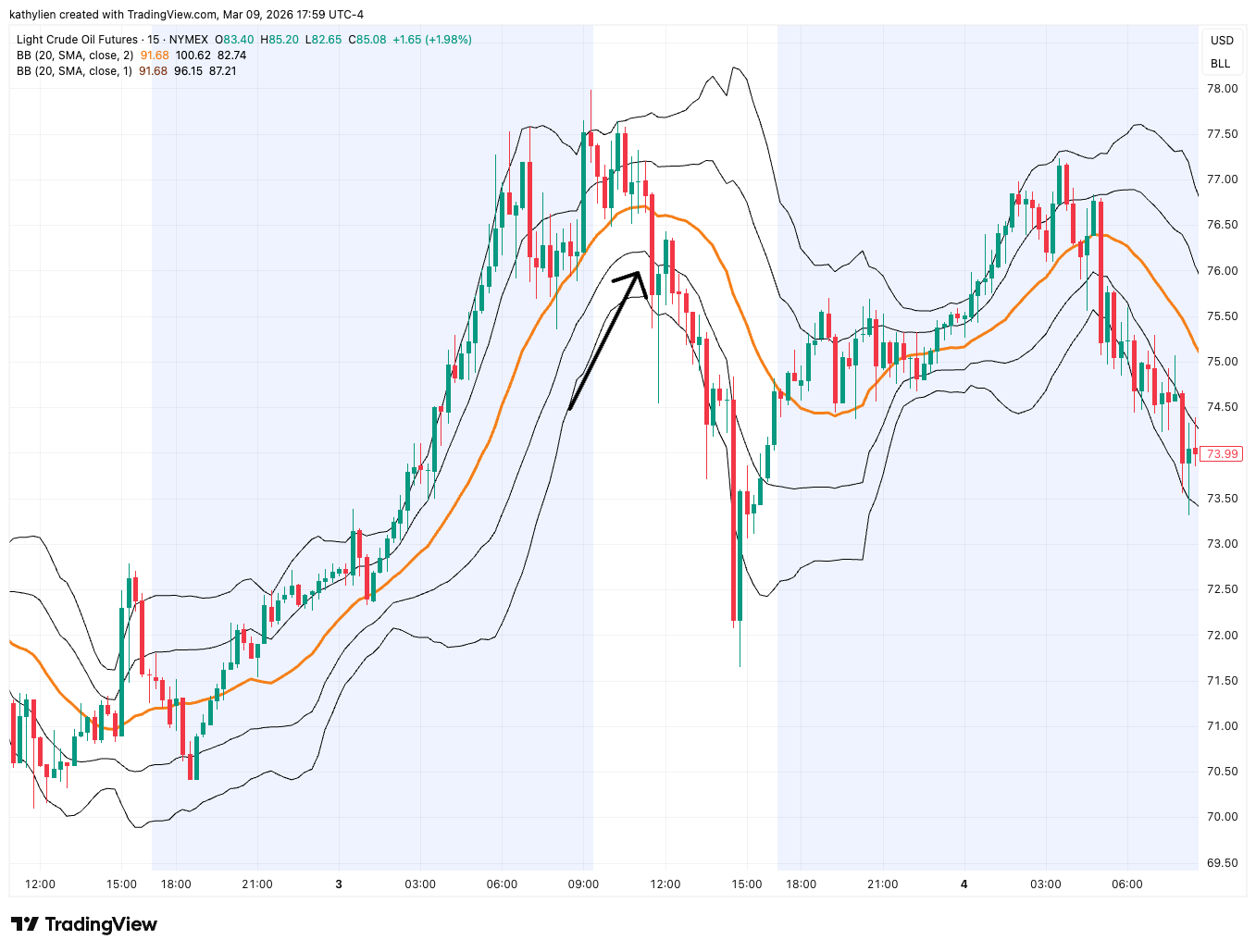
During Monday’s move, once oil closed back below the 20-SMA, the market began a sharp unwind that sent prices tumbling nearly $30 lower within hours. We saw another classic example of this in early March.
Why Confirmation Matters for Prop Traders
For prop traders, confirmation is especially important.
When markets are moving 20 to 30% in a matter of hours, fading a move too early can be extremely dangerous. A sudden spike in volatility can easily trigger trailing drawdowns or daily loss limits, even if your overall idea about the trade is correct.
That’s why waiting for a confirmed turn is critical. The goal is not to catch the exact top, but to enter once the probability shifts in your favor.
Prop traders must always think in terms of risk management first, profits second.
Choosing the Right Prop Structure
Another way to manage volatility risk is by trading with a prop program that offers more flexibility in drawdown rules like Axi Select, which has a different structure than most prop firm programs. Instead of daily or trailing drawdowns that can be triggered easily during volatile markets, Axi Select uses a simple maximum drawdown of 10%.
There is no end-of-day drawdown, no trailing drawdown and no high water mark which makes it easier to manage trades during highly volatile conditions like we saw in oil.
Another major advantage is that Axi Select is completely free to participate in, making it one of the most accessible programs available for traders who want to scale capital.
When markets are moving this fast, having both the right strategy and the right risk structure can make the difference between surviving volatility and getting knocked out by it.